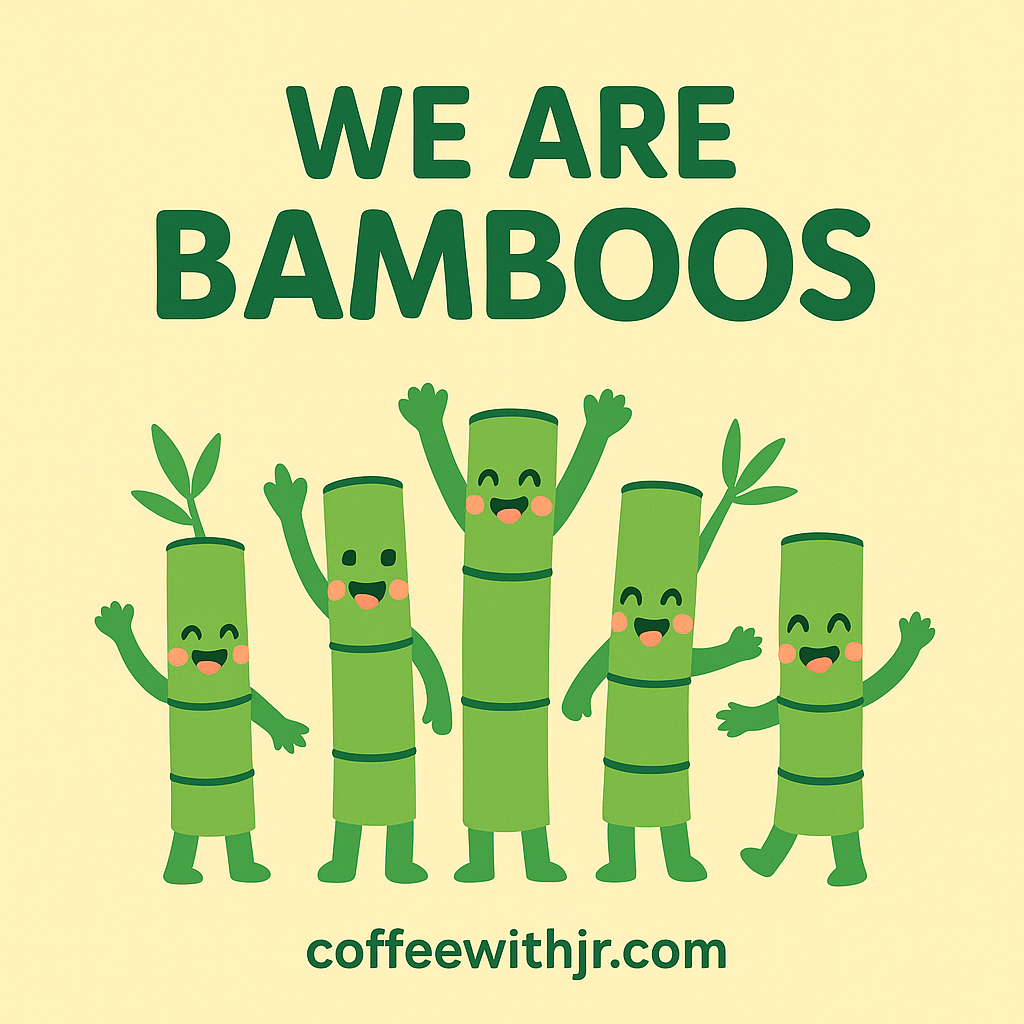
A few weeks ago, I had the privilege of speaking at the Pacific Clinics Multicultural Family Center, where I shared parts of my journey with mental health and immigration. One of my talks was titled “We Are Bamboos – Thriving Between Two Worlds.”
This blog is an expanded version of that speech. I hope that as you read, you’ll find pieces of your own story reflected here, whether in resilience, in healing, or in navigating the space between cultures. May these words offer comfort, encouragement, and a reminder that we are never alone in our journey.
WE ARE BAMBOOS: THRIVING BETWEEN TWO WORLDS
Bamboo has always fascinated me. It’s one of the most resilient plants in nature—flexible enough to bend in the wind, yet strong enough to withstand storms. It grows rapidly, regenerates after being cut, and spreads via a dense root network. In many Asian traditions, bamboo is a symbol of strength, resilience, simplicity, prosperity, and longevity.
In traditional Chinese culture, for example, bamboo is one of the “Four Gentlemen” (四君子), representing summer and embodying uprightness, tenacity, and modesty. In India, bamboo is sometimes referred to as “Kalpavriksha,” the wish-fulfilling tree in myth. Over centuries, bamboo has been used not just as a symbol, but in everyday life: for construction, tools, art, writing scrolls, baskets, and even paper and musical instruments.
When I think about my journey, and the journeys of so many immigrants and children of immigrants, I realize: we are bamboo.
Migration: Crossing Oceans
Many of us come from families who sacrificed comfort for possibility. In the U.S. today, immigrants number around 51.9 million, accounting for approximately 16.3% of the population. Of those, a significant share faces uncertainty about their legal status, access to healthcare, and sense of belonging.
Those who migrate cross physical, emotional, and psychological distances. The act of migration itself often includes trauma—loss, separation, fear, and unknowns. Yet like bamboo taking root in foreign soil, we adapt. We begin to build lives, communities, and continuity in a new and unfamiliar land.
Culture Shock: Thriving in the Unknown
Stepping into a new country means confronting language barriers, cultural codes, and unspoken norms. The first years are often disorienting. In fact, immigrants who have lived in the U.S. for fewer than five years have experienced a 140% increase in rates of severe psychological distress between 2015–2017 and 2019–2021.
Still, like bamboo that thrives in diverse soils —whether rocky, marshy, or otherwise —we learn to bend and adjust. We adopt new languages, climates, and foods, and yet we carry within us the roots of home.
Trauma: Carrying and Healing
We don’t arrive empty-handed. Many immigrants and refugees carry layered trauma: war, violence, poverty, political persecution, and familial displacement. Research consistently shows migrants have higher rates of depression, anxiety, PTSD, and other mental health challenges compared to host populations.
One meta-analysis of migrants in precarious conditions found prevalence rates of nearly 43% for anxiety, 49.5% for depression, and 40.8% for PTSD. Among refugees specifically, depressive symptoms affect about 31.5% on average. First-generation migrants also face a higher risk of psychotic disorders, with a mean relative risk of 2.7 times that of non-migrants.
Immigration policies also play a significant role. Restrictive or punitive immigration environments are linked to worsened mental health outcomes. Detention is especially harmful. Studies show that confinement increases risks of depression, PTSD, and other disorders.
Identity: Living Between Two Worlds
For many of us, identity becomes a battlefield. Too Asian to be fully American. Too American to be fully understood by Asian communities. That in-between space produces stress, guilt, and a sense of not belonging.
A mentor once told me, “Don’t see yourself as 50% Asian and 50% American. See yourself as 100% Asian and 100% American.”
That insight changed me. It helped me see my identity not as fragmented, but abundant. Not as broken, but expanding.
Heritage: Rejecting and Reclaiming
I spent years minimizing my heritage to fit in. The accents, foods, and customs are all hidden or softened. But over time, I found my way home again. I fell in love with the language, its symbolism, and its rituals. And I recognized the depth of sacrifice my parents made and the unseen labor that allowed me to grow unencumbered.
Reclaiming heritage doesn’t mean romanticizing everything. It means discerning, choosing, and honoring where identity gives strength. It means transforming the stories we told ourselves out of shame into ones of dignity.
Racism: Standing Out, Learning to Adapt
Our bodies, our names, our accents often make us visible in ways we do not choose. Discrimination, microaggressions, and stereotypes follow. In immigrant communities, these burdens compound the internal struggle of belonging.
Yet, like bamboo bending but not breaking, we learn strategies of adaptation and survival. We cultivate empathy. We build coalitions. And in doing so, we resist invisibility, refusing to erase ourselves.
Release and Renew
For a long time, I carried a belief that I had to choose: be more Asian or more American. That belief bred guilt, shame, and depression.
Healing taught me a radical alternative: I don’t have to choose. I can be 100% Asian and 100% American. I can let go of the false narrative that I am “less than” or “broken.”
Just as bamboo sheds old, yellowed stalks to allow new growth, we too must release what no longer nourishes us, including outworn beliefs, internalized shame, and inherited trauma, to open space for transformation.
Thriving Together
One of the greatest lessons from bamboo is that it rarely grows in isolation. A bamboo patch is supported by shared roots, where the death of one plant provides soil, space, and energy for others.
Our immigrant communities echo that. We grow in networks of family, friendship, mentorship, culture, faith, and language. When one of us suffers, others hold space. When one of us heals, we all heal a little more.
A Final Reflection
To those of you caught between worlds: know this that you are not broken. You are growing, healing, and thriving. You are not fragmented, you are layered. You are not less, you are whole.
We are bamboos.
We bend, but we do not break.
We carry history, but we make futures.
We heal, we evolve, we flourish.
And even in storms, we root deeper, we stand stronger, and we continue to grow.
Recent Comments